Dynamic end-to-end encryption
Each transmission uses encryption with a token-generated key, with randomness that mitigates replay attacks and packet tampering.
The world's first software-based IoT network
What is the One Protocol
The One Protocol is a proprietary protocol based on Bluetooth Low Energy (BLE), operating at the 2.4 GHz frequency, widely supported by most of today's smartphones.
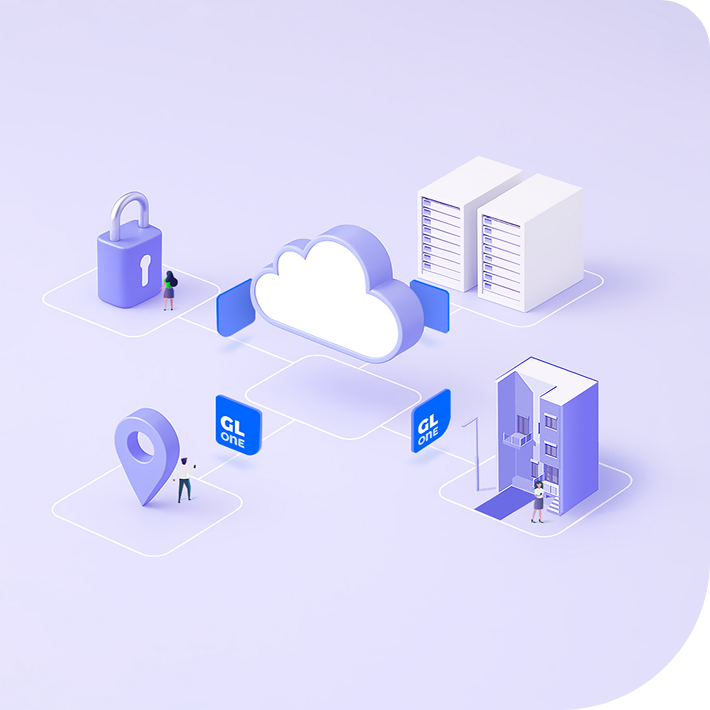
Conventional IoT networks depend on antennas, gateways, or cellular networks to work. The One Protocol uses smartphones with partner apps that have the Group Link One SDK integrated as intermediaries in data transmission, automatically and anonymously, in the background, according to the permissions the user grants the app.
The network is built by software embedded in partner apps, with no need for dedicated physical infrastructure to transmit data. Smartphones with the SDK relay sensor data automatically and anonymously.
Only binary code blocks are transmitted. No personal data is captured. Transmission happens in the background, according to the permissions the user grants. Compliant with LGPD.
Covers the market's leading water, gas, and energy meters. On mechanical meters, compatibility is defined by the brand. On meters with pulsed, reed switch, or ultrasonic output, it's defined by the signal's output type.
Data stays on the Group Link One platform and can additionally be made available via MQTT and Batch for consumption by external systems.
STEP BY STEP
The Group Link One SDK is integrated into the partner's app
The device captures the meter reading
Smartphones with partner apps relay the data anonymously
Data reaches the management platform
WHY THE ONE PROTOCOL IS DIFFERENT
The One Protocol runs on smartphones that already have apps with the Group Link One SDK integrated. The result is the GL One Network, which expands its coverage as the base of partner apps grows and reduces the reliance on dedicated physical infrastructure common to other network architectures.
The One Protocol
SECURITY AS A PILLAR
The One Protocol's architecture was designed to ensure data integrity, confidentiality, and resilience at every stage of transmission, with security and privacy built into the design, not added as an extra layer.
Each transmission uses encryption with a token-generated key, with randomness that mitigates replay attacks and packet tampering.
The protocol captures only binary code blocks related to the meter's consumption. No location, identity, or browsing information is collected.
Advanced controls ensure that only intact, authorized data travels across the network.
Use cases compliant with Brazil's General Data Protection Law (LGPD) since the protocol's conception.
When data stops arriving as isolated events and starts flowing continuously, the operation gains visibility, predictability, and the ability to anticipate.
Continuous data transmission reduces reliance on one-off readings and broadens visibility into the operation, making it possible to follow what happens as events unfold.
The network expands naturally as new points are connected, extending its coverage through software integrations (SDKs) in partner apps, with minimal investment.
Frequent data makes it possible to spot deviations faster and gives the client a basis for more accurate diagnostics and more efficient planning.
We deliver control, predictability, and data so clients can build their own diagnostics.
WHAT BECOMES POSSIBLE
01
Detect losses and anomalies faster.
02
Reduce the cost of field readings and inspections.
03
Monitor the operation continuously.
04
Build individual consumption profiles.
05
Plan and audit consumption more accurately.
06
Make decisions based on up-to-date data.
Next step
Our technical team presents the protocol in detail and shows how it integrates with your infrastructure's reality.