When our phone notifies us about everything, we learn to ignore notifications. But ignoring them has a cost. According to an article by Invivo, the science portal of Fiocruz (Oswaldo Cruz Foundation), the brain automatically diverts part of its attention to the alert, even when we don't touch the device. To stay focused, we spend more mental effort, and that shows up as more fatigue and more mistakes.
The same article points to a long-term effect: notifications teach the brain to expect interruptions, through the reward system. Over time, our attention becomes conditioned to these alerts. Our attention span is finite, and the number of things competing for it keeps growing.
The same logic on an industrial scale
Something similar happens in IoT (Internet of Things), with sensors in place of the phone. IoT Analytics, a German IoT market research firm, estimates 21.1 billion connected IoT devices at the end of 2025, up 14% from the previous year, and projects 39 billion by 2030. Every device can generate alerts, and the attention of the people who operate these systems does not grow at the same rate.
The process industry has been measuring this limit for decades. The EEMUA 191 guide, from the Engineering Equipment and Materials Users Association, is a reference in alarm management for industrial plants. It considers fewer than one alarm every ten minutes very likely to be acceptable for an operator, and treats receiving fewer than ten alarms in the ten minutes following a failure as manageable, though possibly difficult. These are small numbers, and they show how scarce a person's attention really is.
In healthcare, the cost of this excess has already been counted. In April 2013, the Joint Commission, which accredits hospitals in the United States, published Sentinel Event Alert No. 50, a notice on alarm safety in medical devices. Between January 2009 and June 2012, its Sentinel Event database, which collects unexpected occurrences involving death or serious physical or psychological harm, received 98 alarm-related reports, 80 of which ended in death. Alarm fatigue, which occurs when professionals become desensitized to the sound, is among the main factors, and the organization itself warns that the real total is probably higher, because reporting is voluntary.
“AI can filter and prioritize, and the system needs to be designed to respect whoever makes the decision.”
The value lies in knowing when to call someone
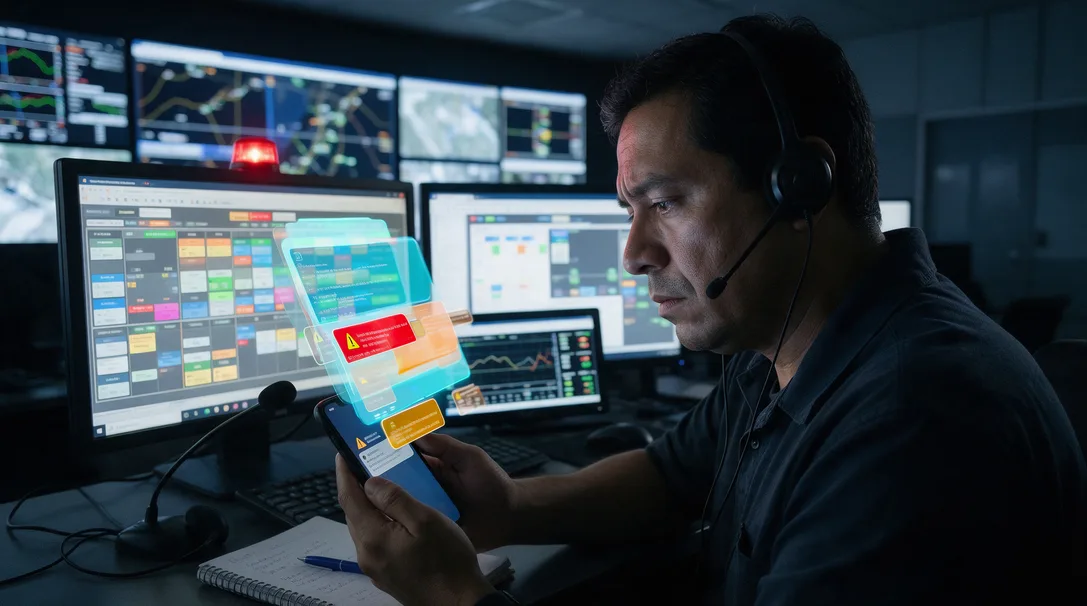
When an alert arrives without context, whoever receives it has to investigate alone, and that person's attention is already being claimed by the other alerts. Calling someone only makes sense at the moment the situation calls for action, and with enough information for them to know what to do.
This conversation becomes even more important with the "AI first" mindset, which puts artificial intelligence first and often gives the impression that it solves everything on its own. At the end of the chain, there is still a person who makes the decision, and they remain subject to the attention limits we saw earlier. AI can filter and prioritize, and the system needs to be designed to respect whoever makes the decision.
How we handle it at home
Group Link One is a Brazilian AIoT (Artificial Intelligence of Things) company for utilities: the water, energy, and gas sector. We deliver a complete solution: sensors and devices that take the readings, and a software and data platform that uses AI to turn those readings into information for the people who operate.
The platform offers different types of alarms, which customers configure according to their operation's criteria, defining the limits and conditions that should trigger an alert when something deviates from what is expected. We want to bring more rigor to something everyone knows, the alert: each alert opens an incident with its context and a record of who acknowledged it and who resolved it, so that every alert deserves the attention it asks for.
If you work with IoT systems, it's worth testing your own operation with two questions: how many alerts each person on the team receives per hour, and what context comes with each one. If the first answer is high and the second is thin, the system is spending the team's attention without delivering a decision in return.
About the author
Thiago Rondon
COO and CTO of Group Link One, with more than 25 years of experience in software development, distributed systems, IoT, and large-scale data platforms.