
The Cantareira System, the group of reservoirs that supplies the São Paulo metropolitan region, started 2026 at its worst level for the period since the 2014–2015 water crisis, closing December 2025 at 20.18% of usable volume and operating under restrictions. In August 2025, the city had already faced water rationing of up to 12 days a month. Even with the recovery recorded over the year, reaching 40.30% in September, the pattern repeats: the reservoir rises and falls with the rainy season, and the next dry spell could bring the level back into the critical range.
The São Paulo case is just a recent example. Water rationing has already affected cities in practically every region of the country in recent years, and the problem tends to come back wherever it has happened before. For a building manager, this kind of swing shows up in a specific way: with no individual warning, the building's reservoir draining faster than expected once rationing kicks in, and residents asking why the water tank can't make it through the day.
Rationing exposes what the condo didn't know about itself
When the utility cuts supply, the building starts depending on what it has stored. That's when a problem that already existed — just invisible — shows up: uneven consumption between units. Two families of the same size, one apartment using twice as much as the other, and no one can say why. Under normal conditions, that difference goes unnoticed in a single combined bill. During rationing, it weighs directly on the shared reservoir, and the whole building runs out of water earlier because of what a few units are using.
“The internal rationing plan ends up based on numbers, not guesswork.”
Three ways monitored consumption changes the crisis
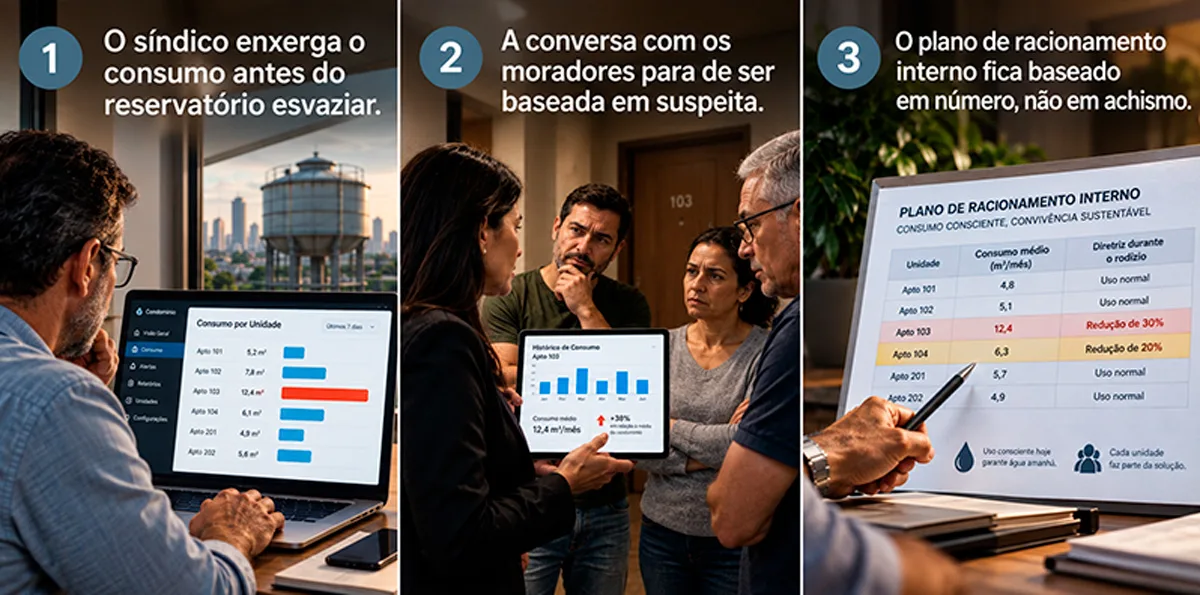
The building manager sees consumption before the reservoir runs dry. With continuous per-unit data, it's possible to see which apartment is drawing more water on a restricted day, and act before the whole building loses water at night.
Conversations with residents stop being based on suspicion. During a crisis, tension rises, and so do accusations. "Someone's using more than they should" turns into a claim with no proof. Per-unit history turns suspicion into fact, or rules it out.
The internal rationing plan ends up based on numbers, not guesswork. A condo that already knows each unit's consumption pattern can set fairer quotas or usage schedules during rationing, instead of applying the same rule to light and heavy users alike.

Whoever already measures doesn't wait for the crisis to act: a condo that continuously monitors consumption enters a rationing period with a concrete advantage — it knows where consumption is concentrated before the water tank drops. That changes the kind of decision the building manager makes. Instead of cutting water for everyone equally, they can target where the problem actually is.
A water crisis isn't a one-off event on Brazil's calendar. It comes back, changes cities, changes intensity, but it comes back. The condo building that history now isn't doing it thinking about the next specific rationing period. It's doing it because, sooner or later, it will need that history again.
About the author
William Oliveira
Contributes to Group Link One writing about consumption management, water crises, and technology applied to condominiums.